31 March 2026
Full steam towards specialised maritime services: a fully‑fledged infrastructure asset class

Specialised maritime services appeal to investors, backed by capital intensity, long-term contracted revenues, inflation linkage and downside protection, say InfraVia Capital Partners’ Aymar de Tracy and LD Armateurs’ Samira Draoua
The specialised maritime services sector operates bespoke vessels designed to carry out specific tasks such as offshore wind farm maintenance or the laying of submarine cables. Fully integrated into customers’ supply chains, the segment benefits from fundamental infrastructure characteristics including long-term contracts with blue chip counterparties, high barriers to entry and inflation protection.
It also provides compelling opportunities for infrastructure investors to consolidate a fragmented industry and deploy capital behind an ageing fleet in need of decarbonisation, explains InfraVia Capital Partners’ Aymar de Tracy and CEO at portfolio company LD Armateurs (LDA), Samira Draoua.
Why does the specialised and dedicated maritime services sector represent an attractive investment proposition?
Samira Draoua:
Unlike standard commodity shipping, specialised maritime services involve operating purpose-built vessels that are designed for critical missions dedicated to a single or very small number of clients. This might include laying submarine cables, transporting oversized industrial components or operating maintenance vessels for offshore wind farms, for example.
What this means is that a company like LDA is fully integrated into the value chain of blue-chip clients such as Airbus and Ørsted, typically operating under 10-15-year service agreements. This makes our business far more predictable than standard commodity shipping. In this sense, we act as an integrated industrial partner, rather than simply as a carrier. We bring technical expertise to the task of delivering complex services with extreme reliability and robust risk management.
Aymar de Tracy:
Maritime services differ from conventional shipping, which is largely exposed to volatile spot markets. In specialised maritime services, operators are embedded within their clients’ supply chains. Clients require bespoke, purpose-built vessels tailored to specific operational needs, and operators such as LDA therefore require long-term visibility on vessel utilisation in order to commit capital and design assets accordingly. As infrastructure investors, you’re able to commit long-term capital expenditure against long-term, contracted revenues with blue-chip counterparties.
In addition, the underlying segments in which LDA operates are resilient and supported by long-term structural growth drivers such as renewable energy expansion in Europe, as well as data consumption and connectivity.
At the same time, a significant portion of the global specialised fleet is becoming obsolete – for example, the average age of cable-laying vessels exceeds 25 years old – driving substantial replacement and upgrade capex needs. This combination of structural growth and fleet renewal needs creates attractive opportunities for operators such as LDA.
How does specialised and dedicated maritime fall within the definition of infrastructure investment?
Aymar de Tracy:
The sector exhibits the hallmarks of infrastructure, starting with predictable cashflows and built-in inflation protection. Unlike the volatile spot market, dedicated maritime services offer infrastructure-like returns with long term charters indexed to inflation and fuel costs.
Barriers to entry are high due to substantial capital requirements. Vessels cost between €50 million and €200 million each, depending on the type of vessel involved, creating significant investment opportunities for financial partners like us. Furthermore, capital intensity is expected to increase in the coming years as decarbonisation and regulatory requirements drive vessel upgrades.
In short, specialised and dedicated maritime services offer the characteristics sought by infrastructure investors: high capital intensity, long-term contracted revenues, contracted ability to pass inflation through to clients and robust downside protection. Of course, this is contingent upon the ability to consistently deliver complex, high-quality services. Clients are demanding and operators like LDA are fully embedded in their supply chains. However, with a consistent and reliable quality of service, this integration puts the operator in a strong position at contract renewal, reinforcing both revenue visibility and long-term value.
Samira Draoua:
I would add that specialised maritime services are critical infrastructure underpinning both the energy transition and digital sovereignty. Offshore wind farms and subsea cable networks cannot be built or maintained without these vessels, creating structural, long-term demand.
How fragmented is the specialised maritime operations market, and what are the consolidation opportunities?
Aymar de Tracy:
The maritime industry in general is very fragmented with many operators owning just a handful of vessels. For example, in the Service Operation Vessels segment for offshore wind, over 80 percent of shipowners operate fewer than three vessels, while leaders typically operate only five to 10. Shipping is an industry where scale matters and investing in digital tools and R&D can bring synergies down the line, favouring larger operators.
In addition to the opportunity to acquire smaller operators owning just a handful of vessels, there are numerous brownfield opportunities where investors can acquire vessels already operating under long-term time charters with blue chip clients.
Samira Draoua:
Another consolidation opportunity lies in purchasing assets from industrial players for whom specialised vessels are non-core. These deals, including sale-and-leaseback structures, allow them to use capital more efficiently and focus on their core business.
One of the driving forces behind consolidation in our market is the opportunity to reach critical scale and to create local champions capable of strategic autonomy. The substantial investment required for fleet renewal and decarbonisation, in particular, is likely to accelerate consolidation as smaller owners become absorbed by larger and better capitalised players.
How is the decarbonisation agenda transforming specialised maritime operations?
Samira Draoua:
Decarbonisation has two principal impacts on the sector. Firstly, regulations such as FuelEU Maritime and the EU ETS impose clear obligations on operators to progressively reduce emissions. This is accelerating investment in R&D and technological innovation to develop lower-emission vessels. However, these initiatives require significant upfront equity to support in-house research and fleet renewal, which in turn is likely to drive further consolidation as smaller operators struggle to keep pace.
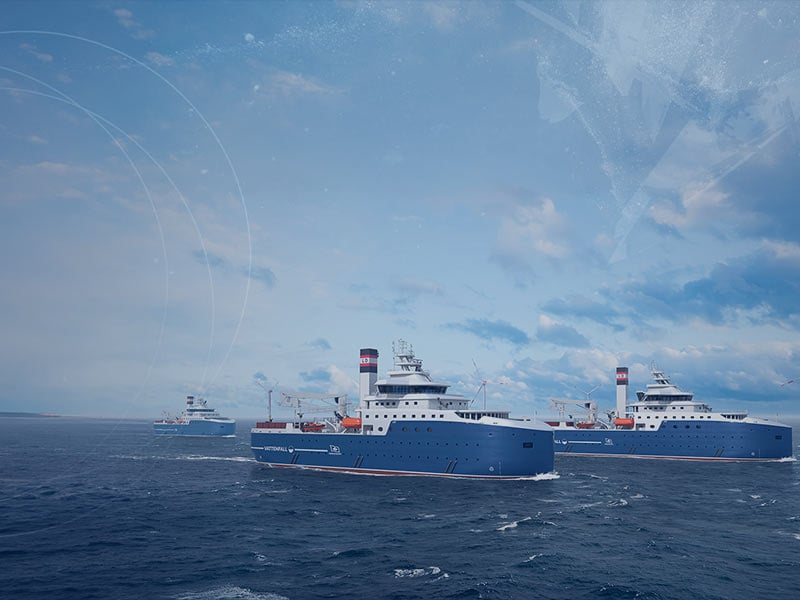
LDA’s approach is to adapt to client needs and offer tailor made decarbonisation solutions. For example, we’re building low emission Roll-on/Roll-off vessels that are equipped with rotors for Airbus and hybrid Service Operation Vessels for Vattenfall. We’re also exploring fully electric and hydrogen propulsion alternatives.
Aymar de Tracy:
We believe that flexibility is critical when it comes to decarbonisation because no technology has yet been identified as the clear long-term winner. It’s important as an operator, therefore, to have a track record and ability of working with and developing all the available solutions.
Ultimately, the technology that we use will be guided in part by regulation and in part by client preference. But we’re clear that LDA’s leadership in fleet decarbonisation is central to our investment strategy and to our role as a contributor to cleaner maritime operations. After all, regulatory requirements are expected to increase the value of green fleets while devaluing older, non-compliant vessels. This will allow modern operators to avoid stranded asset risk.
Beyond decarbonisation, how are players in the specialised maritime services business differentiating themselves?
Samira Draoua:
Differentiation comes from designing haute couture vessels and ensuring operations are deeply integrated in a client’s industrial supply chain. This is critical for missions such as aircraft component logistics or offshore wind operations.
Price competitiveness is also important, of course. This can be achieved through partnerships with leading shipyards, operational excellence and access to specialised financing schemes. Finally, I would point to technical know-how. A fully integrated model, from in-house design to specialised ship management, creates a clear advantage and ensures the uptime and safety standards required for complex and high stakes industrial projects.
Aymar de Tracy:
I completely agree and I would add that the ability to promote business models such as sale and leaseback transactions, which allow industrial companies or shipowners to sell non-core vessels and free up capital, then lease them back for 15 years with inflation indexed payments, is another differentiator. There’s also an opportunity to explore public-private partnerships, as cash constrained governments increasingly turn to long-term maritime capacity leasing.
Many shipowners are family owned. Are there any particular opportunities or challenges that come with partnering with this type of business?
Aymar de Tracy:
InfraVia has partnered with numerous industrial players, founders and families over the years and in all those situations we begin at the same starting point – by establishing a shared ambition and long-term strategy. That’s exactly what happened with our investment in LDA. We aligned with the Louis-Dreyfus family on a shared long-term vision and strategic priorities for the group.
InfraVia provides capital for growth, consolidation and decarbonisation. With us as shareholders, LDA is set to significantly invest over the next few years, enabling the company to more than double its fleet and accelerate innovation, energy transition efforts, and the development of future navigation and maritime service models. The family, meanwhile, is bringing its long history and deep expertise in the sector to the table, as well as providing continuity of culture. We’re here to build a sustainable and scalable leader in the specialised maritime services industry.
Samira Draoua:
The family has retained a significant minority stake at 20 percent, as well as the chairmanship, in order to preserve the group’s core values, heritage and long-term reputation during the planned expansion. Despite upcoming growth, the family led mindset and lean decision making will therefore remain intact, allowing us to continue acting quickly and effectively to offer tailor-made solutions to our clients.
What I would say, based on my experience so far, is that the mindset of family owners and infrastructure investors is very closely aligned, as both are focused on long-term growth and sustainable success.