3 September 2025
Momentum is building behind the European rail infrastructure

Momentum is building behind the European rail industry, with strong demand, decarbonisation, network digitalisation and geopolitical issues driving investment and innovation, say InfraVia’s Nicolas Ritter and Nexrail’s CEO Luuk von Meijenfeldt.
European policy has long supported investment in the region’s vast rail networks, with the push for decarbonisation and more efficient digital technologies a key part of efforts to integrate the sector continent wide. Yet recent developments, including increasing focus on sovereignty and the need for supply chain resilience, are increasing rail’s strategic importance.
Nicolas Ritter, investment director at InfraVia, and Luuk von Meijenfeldt, CEO of rolling stock leasing platform Nexrail – one of the firm’s portfolio companies – discuss how these trends are playing out and what they mean for investment opportunities across the European rail sector.
How is the investment and policy landscape in European rail evolving?
Nicolas Ritter:
As 2025 unfolds amid geopolitical tensions and uncertainty around global trade and climate policy, one clear trend is cutting through the noise across Europe: the need to invest in rail infrastructure. Backed by strong political support and record levels of public funding, rail is emerging as a strategic priority and a long-term winner.
Europe has the advantage of one of the most extensive rail networks in the world. Nearly half of it’s electrified (compared with just around 1 percent in the US, for example), providing a solid backbone with significant potential to scale capacity, improve cross-border connectivity and support the goals of modal shift to reduce the carbon footprint of transportation for both passenger and freight.
Although the latter has been on the agenda for some time, the reality is that Europe’s rail network remains underutilised. That said, momentum is building. The past two decades have seen a series of EU-wide rail initiatives – such as freight liberalisation in the early 2000s and passenger reforms around a decade ago – and the pace is picking up.
This year, Germany announced a landmark €100 billion investment in rail over the next five years, while France committed to increasing annual funding to €4.5 billion by 2028. These moves represent more than just political intent – they’re backed by real financial commitments, laying the groundwork for long-term momentum and attracting growing interest from private investors.
Investing into our network is of paramount importance to increase reliability, security and broader European reach. We expect these major announcements to inject fresh momentum into EU-wide efforts to shift both freight and passenger transport away from roads and skies. In Europe, freight volumes are projected to grow by 2 percent per annum over the next five years, while passenger volumes are expected to increase even faster by 4-5 percent annually during the same period.
Why are these investment announcements happening now when some countries are facing budgeting constraints?
Luuk von Meijenfeldt:
The answer lies in a convergence of broader forces driving this momentum: rail is increasingly viewed as a strategic asset at the crossroads of decarbonisation, industrial sovereignty and even defence. Typically, rail is the only mode that can efficiently move high volumes of goods and people across long distances, which is critical in times of geopolitical stress and is gaining increased attention from NATO and European governments.
From a sovereignty standpoint, a well-integrated and reliable transport network, with rail at its core, is essential. Investment plans are also being linked to shifting trade patterns. As nearshoring gains momentum and we witness elements of “slowbalisation” or deglobalisation, rail will become increasingly important for moving goods within supply chains in Europe.
Simultaneously, several other forces are driving the push to promote rail over other modes of transport, particularly road. These include the urgent need to decarbonise transport, increasing road congestion, truck driver shortages due to ageing and the growing popularity of rail among passengers as a desirable and sustainable option.
How are digital technologies changing the rail landscape?
Luuk von Meijenfeldt:
Digitalisation is clearly opening up exciting innovation opportunities in our sector. One of the most transformative developments is the European Train Control System (ETCS). It’s a digital signalling system that will allow trains to smoothly cross between European countries with maximum safety and increased efficiency. It requires not only refitting tracks across the continent but also adapting or replacing all rolling stock to ensure compatibility with the digital system. It’s a huge programme. This shift is also driving broader demand for next-generation locomotives, which can operate seamlessly on ETCS networks – a more effective alternative to retrofitting older models.
Another key innovation we see changing rail operations is the digital automatic coupler. Today, many operators still depend on manual processes to connect and disconnect wagons – a procedure that’s time-consuming, labour-intensive and presents safety risks. Automating this process with digital couplers improves operational efficiency, enhances safety and allows better utilisation of existing infrastructure.
How is rail investment playing into Europe’s decarbonisation efforts?
Nicolas Ritter:
Rail is a vital lever to decarbonise transportation. According to the European Environment Agency, rail travel is generally three to 10 times less CO2-intensive than road or air transport per passenger-kilometre. Even a modest modal shift – such as increasing rail use by just 5 percent – could result in substantial emissions reductions.
However, challenges remain. Roughly half of the European rail network is still not electrified, and full electrification is not always feasible due to operational, safety or economic constraints. For example, electrifying just one kilometre of rail can cost as much as purchasing two to three locomotives.
This is why innovation is just as important as infrastructure. Rather than pursuing full electrification, we need to deploy cleaner, more efficient technologies that can reduce emissions on non-electrified lines. This was a major part of our investment thesis when creating Nexrail. There are around 30,000 locomotives across Europe, about a third of which are diesel-powered. Many of these are 40 years old on average and need replacement.
Luuk von Meijenfeldt:
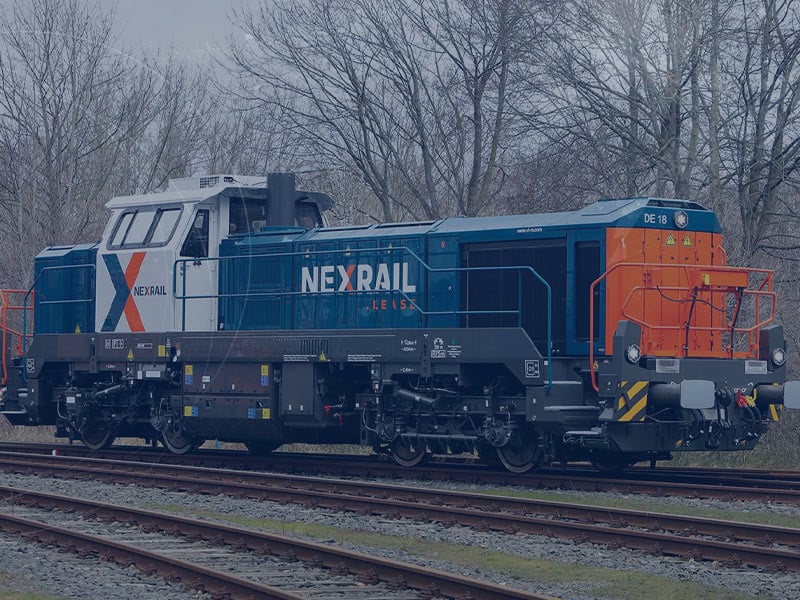
Rail is already one of the most sustainable modes of transportation, but it needs to go net zero. Today, when trains move beyond electrified lines, the market remains almost entirely reliant on diesel. We saw an opportunity to address this by integrating batteries into locomotives. Our first transaction, back in 2021, was a diesel-battery hybrid locomotive, which was the first of its kind.
This type of initiative illustrates our approach well because we believe we have a differentiated, innovative and sustainable product offering. By working closely with manufacturers, we co-create new locomotives that meet the needs of lessees – offering lower operating costs, improved sustainability and designed for the future.
One example of this is the new E6 model that we’re developing, which is a three-axle shunting locomotive. We’re working with a consortium of European partners to develop and deliver a new shunting locomotive that will be full battery. We expect the first one to be operational in 2027.
What kinds of investment opportunities do these trends open in European rail?
Nicolas Ritter:
European rail is a highly diverse asset class, offering a broad array of subsectors and business models. This makes it attractive to a wide spectrum of infrastructure investors with diverse risk-return appetites.
The scale of upcoming investments presents opportunities to provide in-frastructure for construction and main-tenance services. On the rolling stock side, modernisation requirements and rising demand are fueling growth in the operating leasing model.
Luuk von Meijenfeldt:
We see particularly strong invest-ment potential in two key segments of freight locomotives: shunting and mainline locomotives. These two seg-ments represent roughly 20,000 out of the 30,000 locomotives in total in Europe. We continue to see significant traction for innovative locomotives in renewal, market growth and the shift toward leasing – are expected to drive sustained demand and create attractive opportunities for lessors.
Nicolas Ritter:
Lastly, the implementation of the Fourth Railway Package has opened the door to opportunities in the open-access passenger market. While this segment comes with its own set of challenges, it’s an area we’re actively monitoring.
What’s attractive about the locomotive leasing segment, and what are the opportunities?
Nicolas Ritter:
At InfraVia, we were highly convinced by the strong fundamentals of the European locomotive leasing sector: asset-backed, long-term demand drivers, resilient cashflows, inflation-linked and a growing shift toward asset-light models among operators and industrial users.
Yet when assessing the landscape, it was clear that the number of active locomotive lessors in Europe remains limited, and barriers to entry are high. Luuk and his team came to us with a plan to carve out the leasing pool of a European OEM and use that initial contracted base to grow a new platform. The average shunting locomotive in Europe is approximately 40 years old – making it the oldest segment in the market. That’s clearly not sustainable, especially given the increasing demands driven by the trends we discussed ear-lier.
The rail industry is now entering a multi-decade renewal cycle aimed at
modernising its rolling stock fleet.
At the same time, the locomotive leasing model, introduced only about 25 years ago, still has significant room to grow compared to other transportation asset classes. We’re witnessing a broader shift toward liberalisation and more flexible ownership models, with leasing penetration steadily increasing.
Luuk von Meijenfeld:
It’s a high-barrier, high-value segment, where innovation can drive long-term differentiation, especially to address decarbonisation and digitalisation challenges. Entrants with a lean, flexible and innovation-driven model are best placed to deliver the next gen-eration of solutions.
That’s precisely why we chose to en-ter this market in 2021, with the backing of InfraVia, by building a company from the ground up. We began with a carve-out of 53 locomotives – a pool of assets we had carefully identified – and initially focused on dual-mode and hy-brid models.
These locomotives can operate seamlessly across electrified and non-electrified tracks, enabling greater network utilisation, operational flexibility and improved energy efficiency. Since then, we’ve significantly scaled the company and continue to innovate. Today we operate a fleet of 130 locomo-tives, and we’re expecting to more than double that in the coming three years.